CBC Grade 6 Social Studies End Term 2 Exam 2026 · Question 4
a) Identify the vegetation type described: “Consists of tall grass and scattered trees; common in areas with moderate rainfall.” (1 mark) b) List two ways we…
From Test 5 — Term 2: Endterm Assessment 2026 · 5 marks · Topic: Natural and the Built Environments, Vegetation in Eastern Africa
a) Identify the vegetation type described:
“Consists of tall grass and scattered trees; common in areas with moderate rainfall.” (1 mark)
b) List two ways we can conserve vegetation in our school environment: (2 marks)
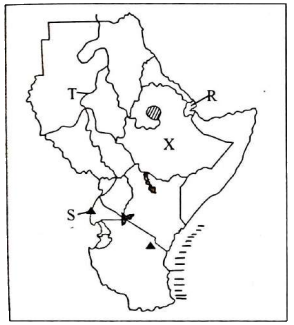
c) Grade 6 learners were studying about physical features found in Eastern Africa?
Name the feature marked T and S (2 marks)
Answer
a) Savanna (tropical grassland). b) i) Plant trees and grass in the school compound. ii) Do not cut trees or burn the bush; water and protect the young plants. c) T: River Nile. S: Rwenzori (Ruwenzori) Mountains.
a) Tall grass with scattered trees in areas of moderate rainfall describes savanna vegetation (tropical grassland). b) Vegetation is conserved by looking after it: plant trees, water and protect young plants, do not cut trees you do not need, stop bush fires and start a tree nursery. c) On the map, the pointer from T touches a long winding river in Sudan, the River Nile. The pointer from S ends at a mountain symbol on the western border of Uganda, the Rwenzori (Ruwenzori) Mountains. The mountain symbol is a clue that S is a mountain, not a river.
Written answers can be worded differently: naQonda marks your own answer and explains it when you sign up free.
More Grade 6 Social Studies questions from this test
- Study the map of Waki area and answer questions that follow. (5 marks) a) State the direction of the dairy farm from…Question 5
- a) Name the language group that migrated into Eastern Africa from the Congo Basin. (1 mark) b) State two effects of…Question 6
- a) List two challenges facing beef farmers in Eastern Africa today: (2 marks) b) Differentiate between marine fishing…Question 7
- Grade six learners at Msingi Bora School drew a diagram as shown below to represent mountain vegetation. Which…Question 8
- Use the map of Eastern Africa provided to answer questions that follow (4 marks) a) The country marked P is; ___. b)…Question 9
- Maria a Grade six learner wrote the characteristics of a certain climatic region in Eastern Africa shown below; i) it…Question 10