CBC Grade 9 Integrated Science Revision Exam · Question 26
The following diagram shows an experiment used to investigate changes in states of matter: (4 marks) TONGS GLASS a) What is the colour of magnesium oxide…
From Test 9 — Revision 3 Integrated Science · 4 marks · Topic: Mixtures, Elements and Compounds, Physical and Chemical Changes
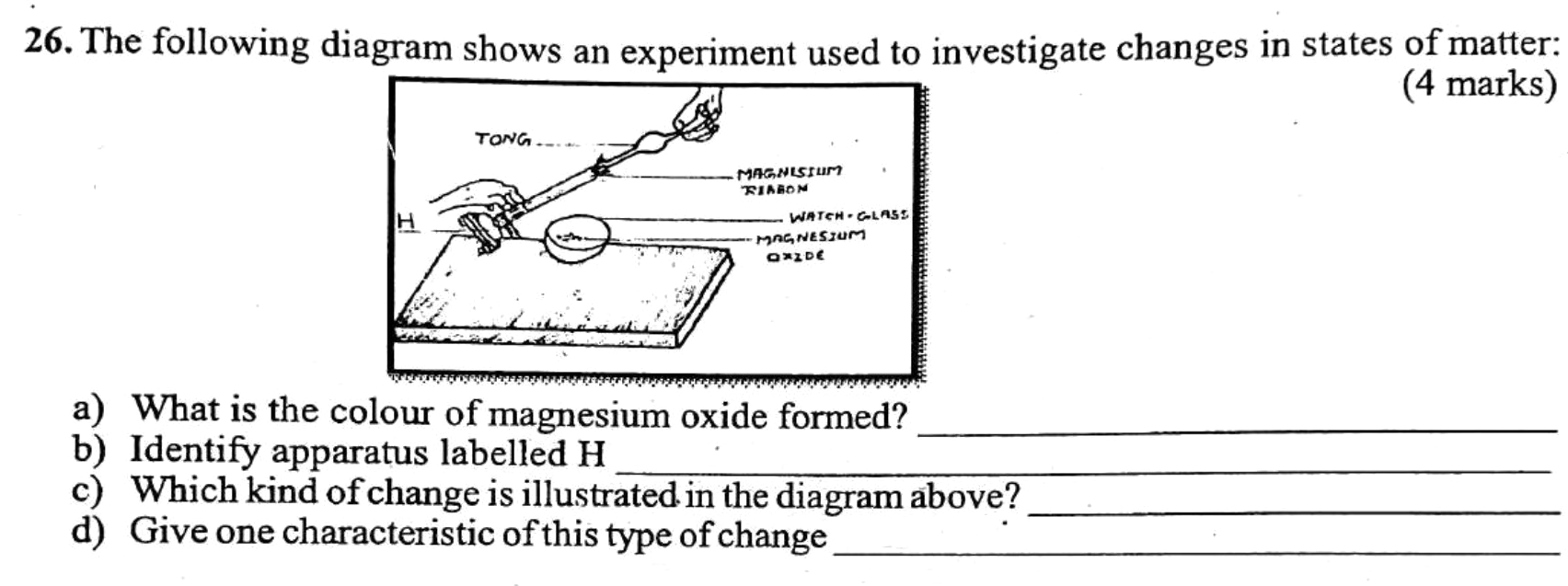
The following diagram shows an experiment used to investigate changes in states of matter:
(4 marks)
TONGS
GLASS
a) What is the colour of magnesium oxide formed?
b) Identify apparatus labelled H
c) Which kind of change is illustrated in the diagram above?
d) Give one characteristic of this type of change
Answer
a) White. b) H is a pair of tongs. c) A chemical change. d) A chemical change forms a new substance with different properties and is generally not easily reversed.
When the magnesium ribbon is held in the tongs (labelled H) and burned, it reacts with oxygen in the air to form magnesium oxide, a white powder, which collects on the watch-glass. This is a chemical change because burning magnesium produces an entirely new substance (magnesium oxide) that has different properties from the original magnesium metal. A key characteristic of a chemical change is that it forms a new substance and, unlike most physical changes, it is generally difficult or impossible to reverse.
Written answers can be worded differently: naQonda marks your own answer and explains it when you sign up free.
More Grade 9 Integrated Science questions from this test
- Below is one of commonly used laboratory apparatus: Use it to answer questions that follow: (4 marks) a) What is the…Question 27
- The diagram below shows a cell. (4 marks) o o a) Give the name of the parts labelled N b) What is the function of the…Question 28
- Jane intends to become a surgeon in future. Which branch of Integrated Science should she major in?Question 1
- Peter boiled an egg for breakfast. The change that took place in the egg is likely to be:Question 2
- Calculate the pressure exerted by a solid of mass 60 kg with an area of 20 m². (Take g = 10 N/kg)Question 3
- An atom is made up of subatomic particles. Which of these particles have negative charge?Question 4